Father
of Legends
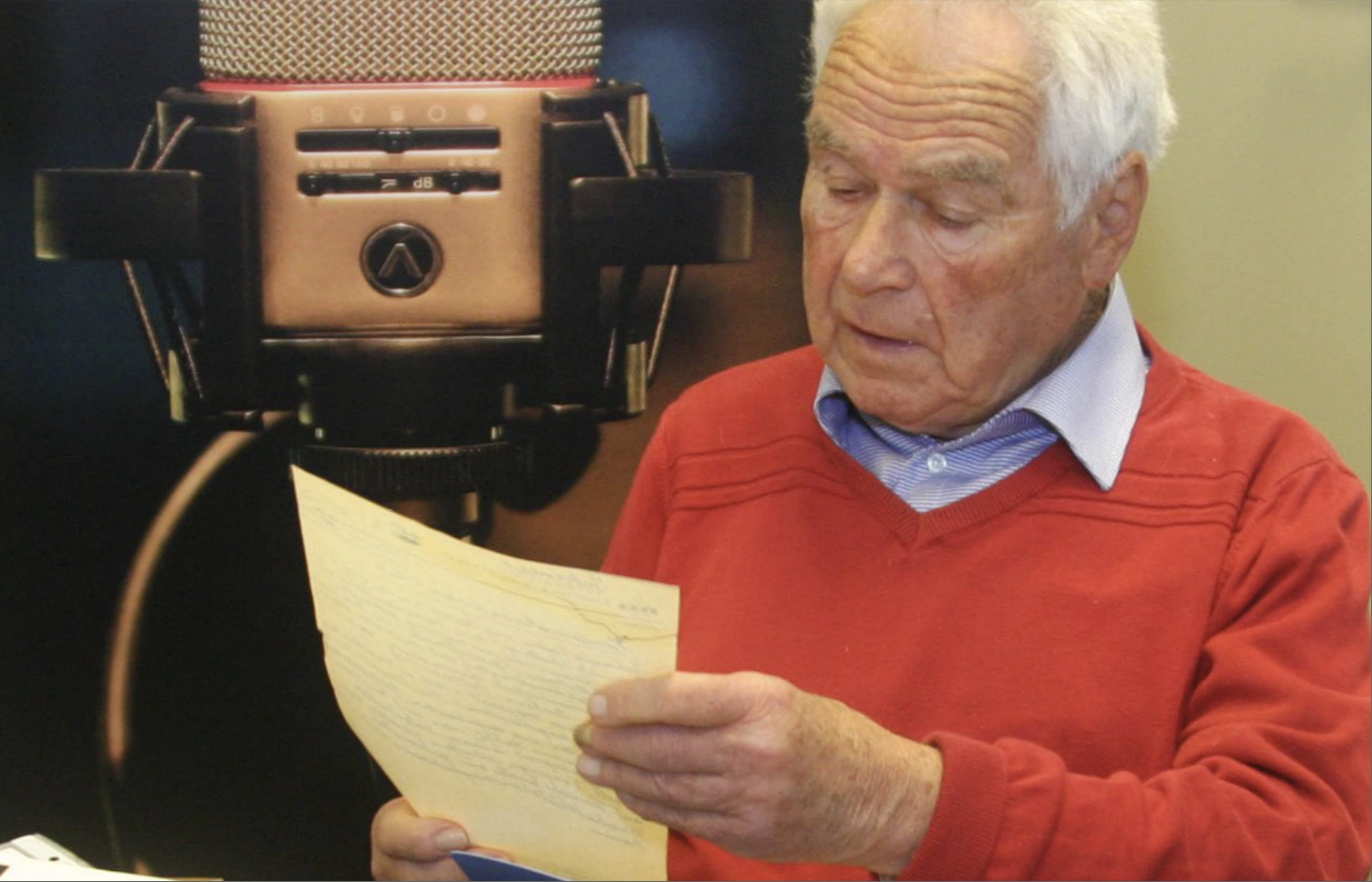
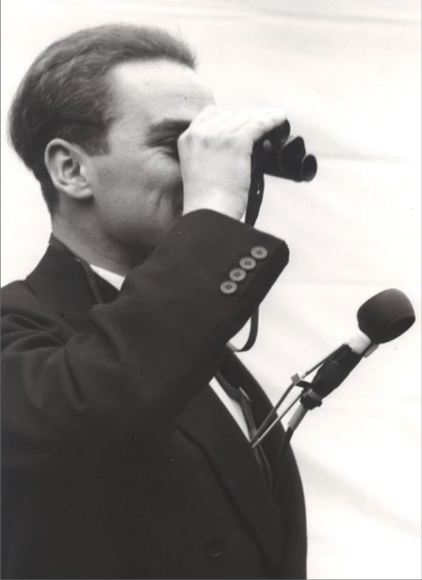
For more than 40 years, Konrad Wolf worked as a condenser microphone developer at AKG in Vienna. Classics such as the C12 and the C414, which can be found in recording studios worldwide, were conceived and built by him. At the time of this interview, he was in his eighties and lived modestly in a Viennese suburb. I met him and Christoph Frank, now microphone developer at Austrian Audio, for an exclusive conversation that brought out some fascinating stories from both experts.
Georg Neumann, Rupert Neve, Robert Moog, Leo Fender, or Les Paul are people whose inventiveness has profoundly shaped the way we record, produce, and listen to music today. Konrad Wolf belongs among them. His name may be less familiar, but Konrad Wolf's influence on the sound of recorded music is no less significant. His developments have left a decisive mark on the sound of music history—from the Beatles, Bob Dylan, and Bruce Springsteen through to Michael Jackson, they all used microphones that Konrad Wolf developed.
A little bit of history repeating
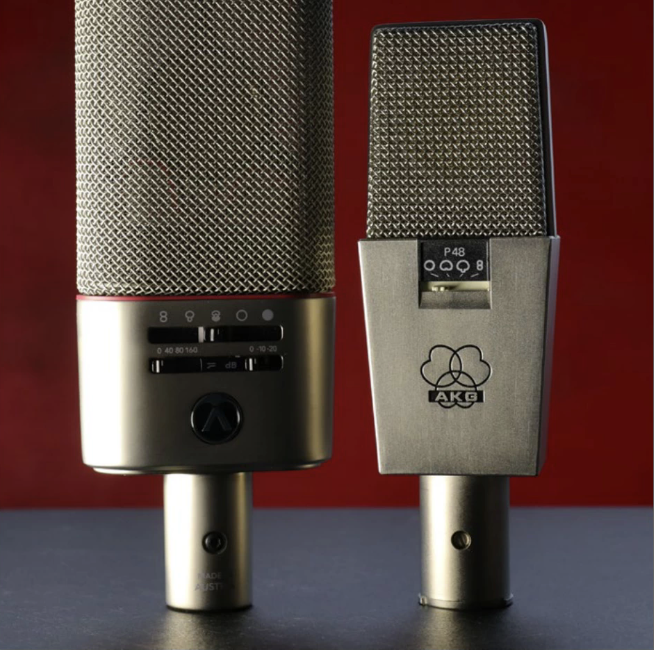
My report about Austrian Audio in the September 2019 issue of Professional Audio inspired this interview. The young company of former AKG employees has developed a new version of the CK12 capsule, modeled on the C12 and C414, and, with the OC18 and OC818, Austrian Audio released two large-diaphragm microphones that have received excellent reviews.
With this story, history seems to be repeating itself a little. AKG was a young company when Konrad Wolf started work there and built his very first condenser microphone, the C12. Austrian Audio has now existed for two years, and Christoph Frank, as Senior Acoustic Engineer, played a major part in developing the OC818, his very first condenser microphone for the pro audio sector.
Two eras—two generations. From the hard years of the postwar period into the new millennium and a pro audio market where everything is available in abundance.
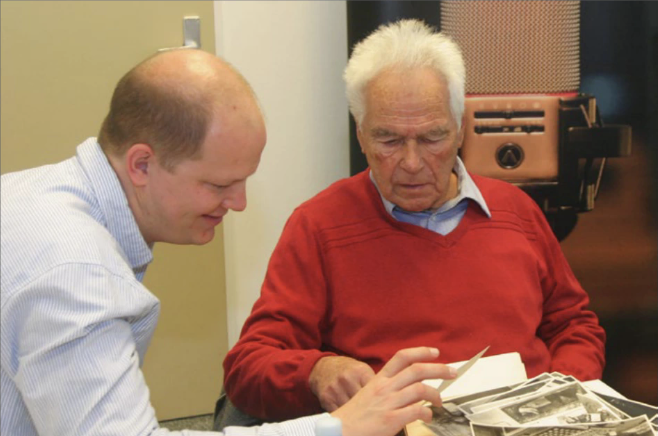
On the day of the interview, Mr. Wolf was accompanied by his grandson, Lorenz. Instead of the hour originally scheduled, he spent three hours telling stories from his own experience, with a generous dose of Viennese charm, taking us on a nostalgic, entertaining, and informative journey into the past.
Austrian Audio CEO Martin Seidl also made a point of joining the interview and enriching this fascinating circle of experts.
The interview: joining AKG and building the C12
Mr. Wolf, I'm extremely pleased that you have taken the time for this interview today. Would you tell us how you came to AKG back then?
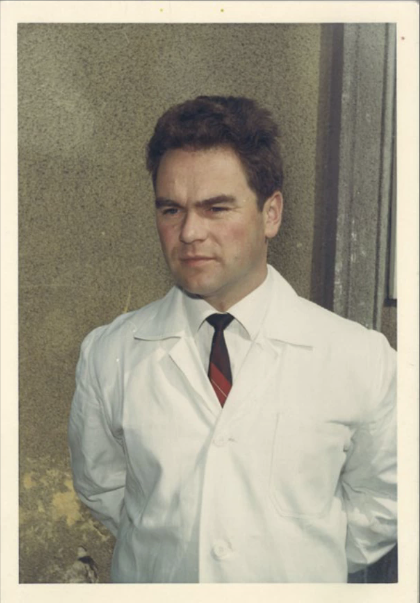
WolfAfter the war I attended the higher technical college in Mödling and studied radio, telecommunications, and cinema technology. One day our class went on an excursion to AKG. When I then passed my Matura (the Austrian school-leaving exam), my homeroom teacher said, “Listen, I've got a job for you, go over to AKG.” He gave me a letter that I couldn't read because it was sealed, and so I simply went there. They took me on straight away. Mr. Pless, one of the founders of AKG, said, “You start right away. Where are you going on vacation?” “Nowhere,” I said, because I had no money. Then he called the secretary and said, “Mrs. Geißler, give Mr. Wolf 300 schillings.” That was my first pay and half of my monthly earnings.
So that let you go on vacation?
WolfI didn't go. I bought myself a bicycle. Well, not bought—I put a deposit on it (laughs). That was 1952 and I was 20 years old. At AKG I joined the “Labor” (the lab), which is what technical development was called in those days. There was only Mr. Kimla, and I became his assistant. But Mr. Kimla spoke very good English and soon started making contacts with other companies and writing operating manuals, and eventually he moved into sales. Then for quite a while I was all alone in the lab. Dr. Görike, the second AKG founder, and I were the entire development team. In the morning Dr. Görike would come in and say what ideas he had. Then he left again and I tinkered away all day.
What were your first developments?
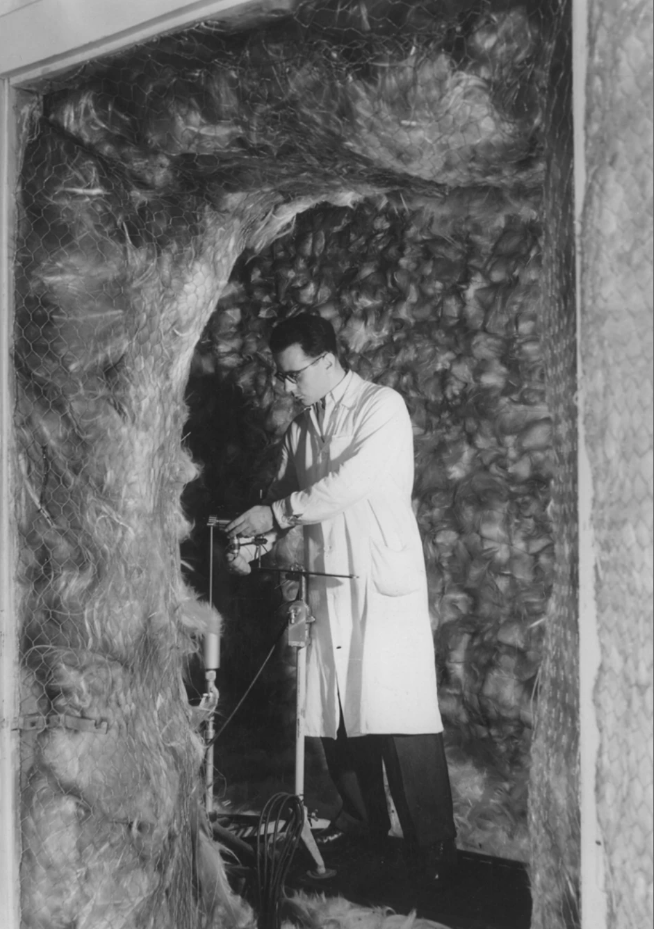
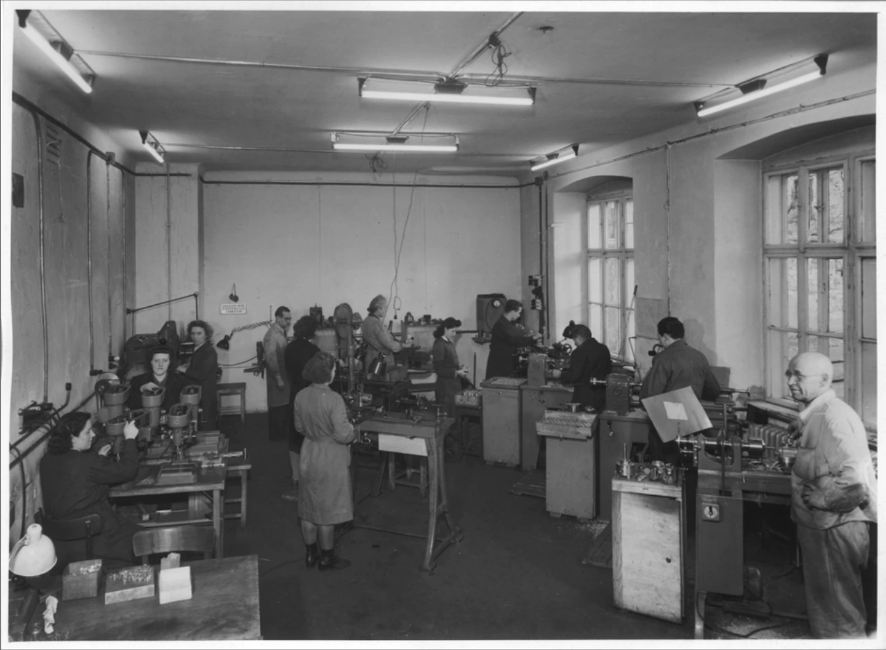
WolfWhen I joined the company, the first thing I heard was: “Mr. Wolf, we are building a measurement room and it will be lined with glass wool.” Then the truck arrived and unloaded glass wool in the yard, and we installed it in a room. They wanted to give me a worker, but he quit again right away, because he had a child at home and didn't want to touch the glass wool. I touched it and looked the part afterward. It was bad, because the fine glass dust got in everywhere. At first there was no covering.
Once we had the measurement room, I did whatever came up. We weren't purely a microphone company, after all—we made everything. For example, a horn for the Lohner scooter, or a pillow loudspeaker for hospitals that could even be washed. Optical sound systems for movie theaters were part of it too, and for Hans Hass we made underwater microphones and even underwater loudspeakers. In between there were underwater housings for Leica cameras, and flash units as well. The first microphones were the C12 and the D12. For a children's hospital we developed contact microphones to record the fetal sounds of unborn children. There was also a documentary series on Austrian Broadcasting (ORF) about fish, and our microphones were used to research the language of fish.
As a young man, did you ever dream of building microphones?
WolfNo. I didn't even know how they worked. I got hold of a book by Olson on electroacoustics, and that became like the Bible for me.
“I didn't even know how they worked. I got hold of a book by Olson on electroacoustics, and that became like the Bible for me.”
Konrad Wolf
How did it come about that you developed the C12 in the early 1950s?
WolfWhen I arrived, the first samples existed, but nothing worked yet. Neumann's M49 had just come onto the market, the so-called “bishop's miter,” because of the cylinder and the grille cap. We analyzed it; it worked flawlessly. But then we measured the frequency responses and they weren't all that special—in figure-eight in particular there was quite a drop in the bass. There were also large level differences, and the potentiometer on the power supply made a great deal of noise when switching. Those were all points we wanted to avoid and do better.
Then Austrian Broadcasting set the requirement that we should develop the microphone in the size of a pencil. Ideally it should be invisible. That was impossible, of course—if only because of the power supply and the tube with its rubber mounting. On top of that, everything was built with discrete components, which takes up a lot of space. We tried to stay as small as possible. We had already defined the capsule diameter, and we ended up with a microphone diameter of 42 millimeters, which was much slimmer than the Neumanns. That was our “Austrian pencil.”
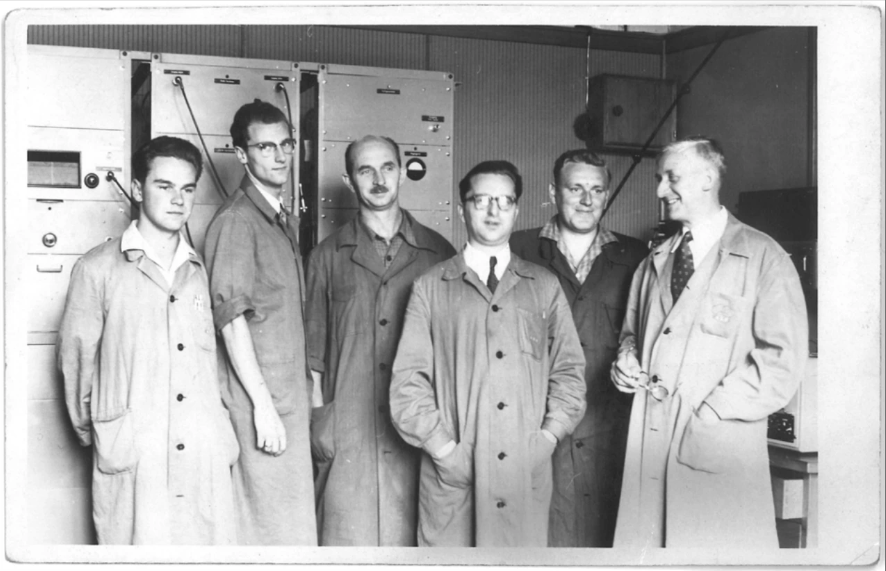
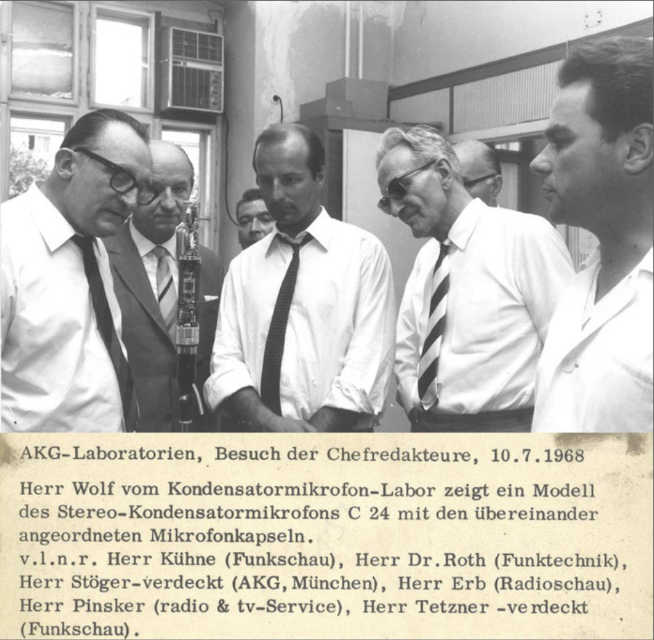
But we had many technological problems that must seem odd to you today, Mr. Frank (turns to Christoph Frank). For example, how do we produce an electrode that is absolutely flat on both sides? We kept asking ourselves: “How does Neumann do it?” Mr. Gemperle, who had been a student of Prof. Sennheiser and later opened an AKG agency in Munich, tried to get information about that. One day he came and reported: “At Neumann there's an old man with a very old lathe, who has set it up so that he can turn everything flat.” To Mr. Gettinger—who can also be seen in the picture where we are all standing together (the early-1950s group photo, ed.)—I then said, “Mr. Gettinger, Neumann does this on a lathe and you can't manage it?” “Well, of course I can manage that,” he said, and he tried out every possible lathe, had them specially adjusted and then took the best one—but it didn't work. The electrodes were either conical or were out by 3 to 4 microns. That was far too much.
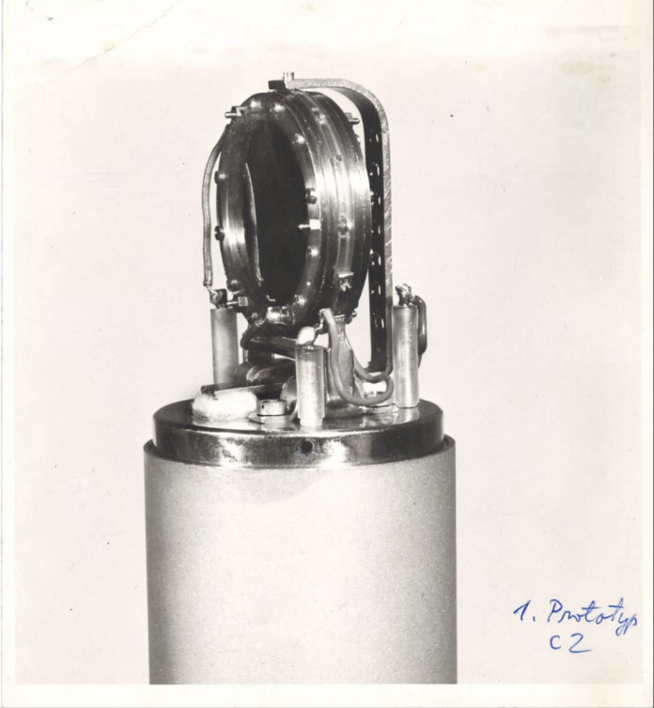
Apart from lapping (a polishing process, ed.) we found nothing that would get the electrode flat, and it all had to be done by hand. Lapping paste was applied to a cast-iron plate, and a woman then moved the part in circles on it, taking it off again and again, washing it and checking it until it finally fit. We only had a straightedge to check it with, but with that you could already detect a difference of one or two microns. It was an enormous effort.
Another problem was the glue. Today there are thousands of adhesives, but they didn't exist then. Two-component adhesives were just being developed, and there was a very small company in Vienna that mixed it for us. Tensioning the diaphragm wasn't easy either. If it wasn't even, you didn't get nice polar diagrams. Originally we used Styroflex film, but it developed cracks over time. Then I found polyester film at DuPont in England—thank goodness they had just started making it.
“I built the first hundred CK12 capsules myself.”
Konrad Wolf
Handmade capsules, AKG's rise and the road to the C414
How many C12 microphones were built per month?
WolfNot many, it was all handwork. One or two women produced around thirty C12 microphones a month. I built the first hundred CK12 capsules myself. With the many little screws, the spacer rings, and everything that goes with it. That's nearly fifty parts—it was quite complicated. I could never do that today. I remember that right at the beginning I was alone in the company one Saturday and Mr. Pless came in and said, “Well, you haven't got anything done anyway, have you?” “Oh yes, Mr. Pless,” I said, opened the little drawer and showed him 18 capsules that I had built and measured in one day. Working capsules, mind you, with the frequency curves neatly folded alongside.
As a developer you had to be a jack of all trades back then, didn't you? Electronics engineer, chemist, design engineer, metalworker…
WolfYes, a little bit of everything. There was nothing after the war; it was an economic crisis. From 1954 things started to look up. That year Mr. Gemperle got to know Mr. Grundig. On a sailing trip on Lake Starnberg, Mr. Grundig told him that he now wanted to build tape recorders. He would need small microphones that he could supply with the tape machines. And we built those for him. That was the big upswing for AKG. Over the following years it took hold to such an extent that we supplied almost every company on the market—Grundig, Telefunken, Nordmende, Saba—with our microphones. We made these microphones in various designs, and they were the first AKG mass product. Before that there had mainly been small runs of 50 units or even fewer.
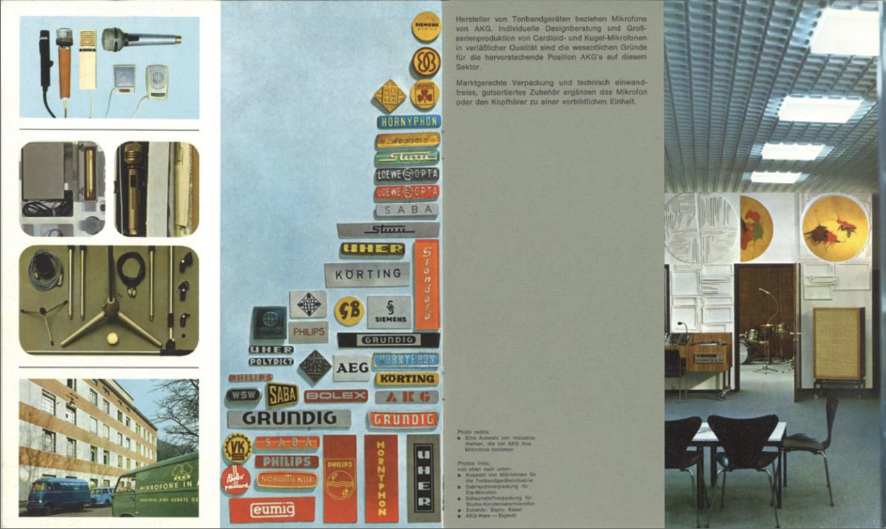
When AKG was founded in 1947 there were only five employees. In 1952, when I joined, there were already around fifty, and by the end of the 1950s the upswing had taken the headcount to six or seven hundred. In the mid-1980s it peaked at around a thousand employees.
How long were you with AKG?
WolfMore than forty years. I retired in 1993. The first computers, the 386s, were just coming onto the market. I still had one of those. Later I dropped by AKG a few more times, but I wasn't allowed to do anything anymore, otherwise I would have earned extra money and they would have canceled my state pension. Since then I have met regularly in Vienna with former AKG employees for a kind of retirees' get-together—although the circle of colleagues is sadly getting smaller and smaller…
That suggests a strong bond within the company.
WolfYes, certainly, you could also see that when Mr. Rührig, who now works at Austrian Audio too, organized the 70th anniversary celebration in 2017. It was very nice, and more than 330 former employees came. I would have lost any bet on that. It is of course a terrible shame that things ended that way with AKG. The main plant and office building were just up here in Lemböckgasse. Now cardboard packaging and toilet paper are made there.
Mr. Frank, you are now in your mid-thirties. Would you tell us a little about how you came to build microphones?
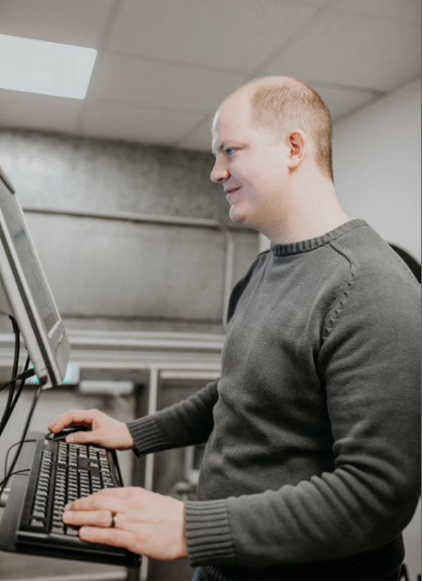
FrankFor me it was completely different from Mr. Wolf. I came to the profession through music. I played in bands, and someone always had to take care of the sound. I thought it would be great to do something in the studio field and then studied electrical engineering and audio engineering in Graz. In 2010 my first job was building cell phone loudspeakers, which was still a long way from the studio. In 2015 I joined AKG and developed microphones for automotive use, that is, for vehicles. The OC818 is my first studio microphone and, for me personally, an absolute highlight, because in terms of my personal development I have finally arrived.
As a musician I naturally find it more exciting to build studio microphones. Even if cell phone loudspeakers or automotive microphones are sold by the million—during development you build an almost personal relationship with the OC18 or OC818. Sometimes you hate it, when things aren't going so well, and sometimes you love it.
Did you have a personal relationship with your microphones too, Mr. Wolf?
WolfNot really. But it did interest me very much—including everything around it and the important impulses from the market. Just sitting at a desk thinking about what you could do doesn't work. Back then there was already the teleprinter and later the fax machine. Lots of suggestions and ideas always came from America.
FrankDid you ever make music yourself? Did you use your own products?
WolfOnly for fun. I once started playing the accordion, but it wasn't a priority.
FrankWhen we developed the new CKR12 capsule and the two microphones, the exchange with musicians and other sound engineers was very important to us very early on. What was that like when you developed the CK12?
WolfWell, originally the brief was that we should build a microphone with a dead-straight frequency response—it was supposed to be completely linear. With the first production runs it was. In the mid-fifties FM radio was introduced in Austria, and because of the equivalent noise level of up to 23 dB we were told the mic was a bit too noisy. We should change something. So I changed the volume and the frictional resistance of the capsule. That improved the noise, but it also gave a treble lift of 3 to 4 dB at around 5 kHz; unfortunately the frequency response was then no longer quite linear.
FrankYes, and that is exactly the sound everyone is looking for today.
Can you say how many products you worked on during your time at AKG?
WolfNo, I can't. I have a whole pile of old brochures at home, and when I looked through them I no longer even knew that I had done all that. Over the course of a lifetime it was a great deal. I can remember spending a lot of time on the ultrasonic capsule and the ultrasonic loudspeaker. Ultrasound used to be used for television remote controls, before infrared existed. That was in the range between 20 and 40 kilohertz, and we supplied transmitters and receivers by the hundreds of thousands to various companies. I can also remember the first hands-free system for the Mercedes S-Class in the late eighties. There were many acoustic pickups too. I only developed one pair of headphones, the K340. And of course all of AKG's condenser microphones, including the C414 series from the beginning up to the B-ULS.
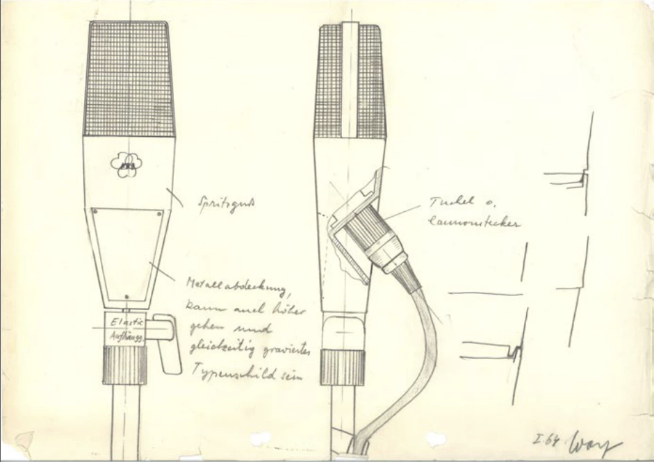
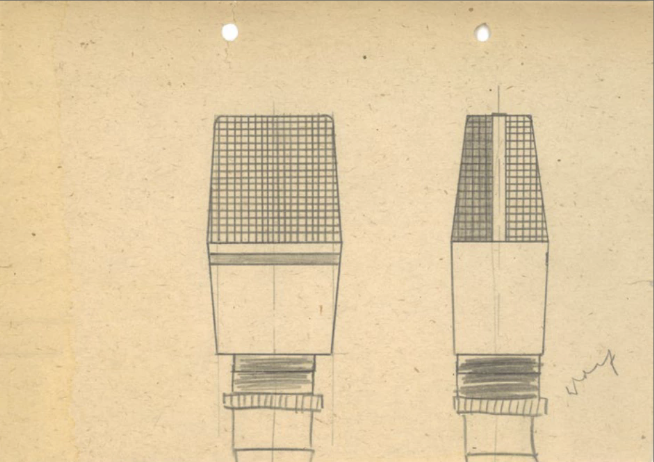
Since you've just mentioned it: there is a drawing of the C414 in the AKG book by Karl Peschel. That's yours, isn't it?
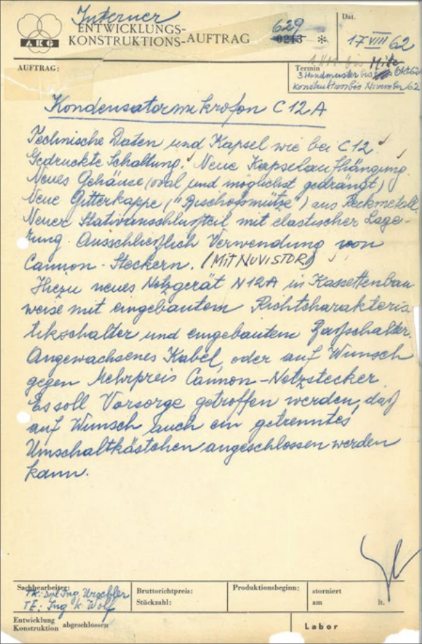
WolfYes, that's a hand sketch of mine. There was a development order for the successor to the C12, which at that time was still called the C12A (reads) “printed circuit, new housing, new grille cap (bishop's miter), exclusive use of Cannon, i.e., XLR, connectors…”—that's what it looked like in those days. I always had a fair number of such orders on my desk and worked through them by priority.
So you were not only an electronics engineer, chemist, and so on, but also a designer…
WolfYes, I thought to myself, I'd like a somewhat more modern bishop's miter.
FrankI find that extremely impressive. When Austrian Audio was founded there were 25 of us, 18 of them developers, and you were 50 employees with only one in development. That would be unthinkable today. There is also a very strict separation today between acoustician, design engineer, and electronics engineer. With the new CKR12 ceramic capsule, for example, it was my colleague Michael Balac who did the mechanical design. We thought it through together, but he then implemented it mechanically and came up with this ingenious screw fastening.
“I thought it was worthless.”
Konrad Wolf
Materials, tubes, the vintage boom and the CK12 today
WolfI also experimented with ceramic as an insulator back then. We had no luck with raw ceramic; it was problematic with humidity. Glazed ceramic like that didn't exist yet—it has probably only been around for a few years, hasn't it?
SeidlYes, above all with this robustness. It is technical ceramic; even if the capsule falls on the floor, it doesn't break. It gives us the specific weight of brass and the acoustic performance—without all the screw work that was necessary then. Nobody could afford that in production today.
WolfIt was far too expensive even then. The capsule wasn't designed for mass production. In the seventies a CK12 cost 500 schillings to manufacture. Then came the instruction to build a new capsule, which was to cost only 100 to 150 schillings. In the end it cost 200 schillings anyway, but it no longer had to be lapped; the surface was now eroded. The screw work was gone too. That was the plastic capsule, which can still be found almost unchanged in the C414 today.
FrankWhen the first transistors came onto the market in the sixties, what was that like for you?
WolfWell, before that I had often spent a lot of time looking for suitable tubes. When the BBC ordered the first C12 microphones, they said, “Very good, but this simply won't do.” There was a tube from the German company Hiller inside, and so shortly after the war the English didn't want a German product. They had an aversion to everything from Germany. I searched for a long time and then found a 6072 dual triode—but only the one from General Electric; that was the best. That American tube, in turn, could not be supplied to Russia, because there was a trade embargo on account of the Korean War. Then I found a comparable type from Siemens. It wasn't as good, but the Russians took it.
For the C12A, the forerunner of the C414, I then used a miniature tube, the Nuvistor. It didn't prove itself, though. The Americans wrote in a letter: “It really ought to be called the New-Whistler.” Some of them must have had a problem with the vacuum, and then the tube developed a faint whispering noise. When the first transistors came onto the market we tried them, and it worked straight away in the first microphone. Then we used transistors and everything got smaller. We then had our own electronics department, where Mr. Wurzer also worked.
FrankYes, he is working with us again today. I can hardly imagine how difficult it must have been back then to find the right materials. Today I look on the internet and find everything I could possibly need.
WolfThere were small companies, some of them basement workshops—we had to search a lot. Gold sputtering, for example. Who vapor-coats a film with gold? In Vienna we found an optical firm that coated lenses. Then we stretched our plastic films onto A4 frames and drove over there again and again to have them coated with gold. It was all handwork. We also had a machine shop in-house, and for the C12, for example, we made almost all the parts ourselves.
In the eighties AKG brought out “The Tube.” Neumann resisted making tube microphones again for years.
WolfYes, that was retro; I did that one too. Demand was very high and we were told we should bring something like that back onto the market. I remember that the first The Tube came straight back from America. We had painted it brown, but the Americans said, “No, we don't want this Nazi microphone.” Then we changed the paint finish.
What do you think of the current vintage trend in the music market? Many companies are trying to recreate their developments of that era—some made by hand in very small runs, or, for example, CK12s produced cheaply in China by the thousand. In return the old models keep getting more expensive. I recently saw a well-preserved C12 offered for €15,000.
WolfPardon, what does it cost?
€15,000.
WolfYes, but what do people do with it? That surprises me; I have no idea why that is. I thought it was worthless. My grandson Lorenz recently enlightened me—he found a C24 on the internet and asked me what I thought it was worth. I said maybe 800 euros or so, since it was a top model—in fact it was being offered for over 20,000 dollars. Why is that? Is it still being used? Surely you would fit a new capsule… If I really need a microphone nowadays, I'd buy something more modern, wouldn't I?
Some owners certainly record with them; for others it is an investment. Tonally, a C12 has a special magic, above all in the upper frequency range, that is considered unmatched today. Mr. Frank, how did you deal with that? The demands and expectations in building a new CK12 capsule must have been incredibly high. Can such “magic” be measured at all?
FrankI first reduced it to the capsule and wanted to decode all its secrets. Why is the CK12 the way it is? Why does it have this incredibly good rejection of almost 20 dB right down into the low frequencies, and why is the frequency response so constant across the different polar patterns? You hardly find that in any other microphone. I think the trick was that I approached it quite scientifically and put the magic spell to one side. You also have to dare to take an original CK12 apart and analyze it precisely. It is simply precision mechanics par excellence.
For us, too, everything began with building the large anechoic measurement room, and basically I didn't have it as hard as Mr. Wolf, because we have so many possibilities at our disposal today. In production we can also measure, laser-guided, to an accuracy of half a micron. That naturally gives us tremendous precision in manufacturing. We then measure every single microphone again for over ten minutes in the anechoic chamber in every conceivable position and pattern. Our tolerances are set very tightly at 0.5 dB. As a result, any OC818 can be used as a stereo pair with a second OC818 or even with the OC18.
WolfIn the past we always said, a difference of 2–3 dB, nobody hears that. You can see it in the measurement, but as a technician without trained ears you don't hear it. Musicians and sound engineers hear it, though. We once had an American in the company who wanted to buy thirty CK12 capsules. He selected them from more than a hundred and auditioned them using only his voice. “I want this one… I don't want this one… I want this one…” It went on like that all day. He was highly satisfied in the end—for me all the capsules had the same frequency response. But at AKG we always measured every microphone before it was delivered, too.
“In the past we always said, a difference of 2–3 dB, nobody hears that.”
Konrad Wolf
Mr. Frank, why is it not possible, with today's precision, to build a completely exact copy of the CK12 capsule?
FrankThe CK12 is a masterpiece and requires a very delicate touch in assembly. That can't be done with automated processes. It needs trained hands and years of experience. It would be possible, but it's a question of cost, because handwork is very expensive. In Vienna there is Mr. Markus Sauschlager—he is one of the best in the field and still builds CK12 capsules true to the original. But those are one-off pieces and only very few capsules a year.
Mr. Wolf, the CK12 capsule was also used in the ELAM 251 / 250. How did the collaboration with Telefunken come about?
WolfI'd like to know that too (laughs). For Telefunken I only did the capsule installation and the acoustics, that is, the microphone basket. Mr. Reinthaler took care of the electronic design. Telefunken originally distributed Neumann, but they must have fallen out. Then Telefunken wanted the same microphones from us. That was only a short period of two years—then we were left sitting on a few hundred mics. Why, I don't know. We then sold off the remaining microphones cheaply in Vienna as surplus stock.
FrankDo you still have a few mics today as an investment?
WolfNo, not at all. For years we held a clearance sale of the old equipment, and then we went on ski trips with AKG on the proceeds. Every winter there were AKG races. Nobody could have guessed then that it would be worth something one day. I still have a Neumann level recorder, a pistonphone, and a BX20 reverb unit at home.
“Nobody could have guessed then that it would be worth something one day.”
Konrad Wolf
FrankWith a level recorder and a pistonphone you could start developing again right away. You would just need a tone generator, but any mobile phone can do that today.
SeidlSo we could hire you to develop again at any time, Mr. Wolf?
WolfThat depends on the salary… (laughs). No, joking aside, unfortunately that's no longer possible.
The C12 is now 66 years old. Mr. Frank, the OC818 was introduced this year—if we look 66 years into the future, may I get in touch with you again in 2085 to look back on the past, as I am doing today with Mr. Wolf?
FrankIf I'm still in as good shape as Mr. Wolf by then, gladly. The invitation of course extends to you too, Mr. Wolf.
LorenzYou could have yourself frozen, Grandpa.
WolfYes, but… that's bound to be very expensive (laughs).
Did you know Konrad Wolf, or work with his microphones?
I'd love to hear your memories or thoughts on this interview.
Your message is sent to me by email and not stored on this website. See the privacy policy.